World War I was quite possibly the most important war in history, with the introduction of modern technology and new battle strategies this war transformed the world. This influence made its way into the art world and produced some of the most shocking and grim works. The subject of many paintings and artworks of this war showed just how deadly and unforgiving it truly was. In this blog you will see a recurring theme of modern warfare and the horrific reality of war.

Sargent, John Singer, 1919, Great Britain, canvas, oil
Support: Height 2310 mm, Width 6111 mm
Frame: Depth 120 mm, Height 2700 mm, Width 6500 mm
This piece by John Singer Sargent highlights the how modern warfare created a whole new beast for soldiers to fight. This particular painting shows soldiers after a mustard gas attack. Mustard gas attacked the eyes hence the bandages on the soldiers eyes. Surprisingly enough upon closer inspection you don’t see expressions of agony on their faces and in the far distance you can see a game of football being played. What draws me to this painting is the different levels and the amount of detail put into each individual. When I first saw the painting I was convinced it was actually a photograph. I really love the wash of of olive toned grey in the background, it really sets the mood for WW I and the chemical weaponry used in this war. It is cliche but I would really love to own this work, if not as a tribute to those who had experience the cruel reality of this war.
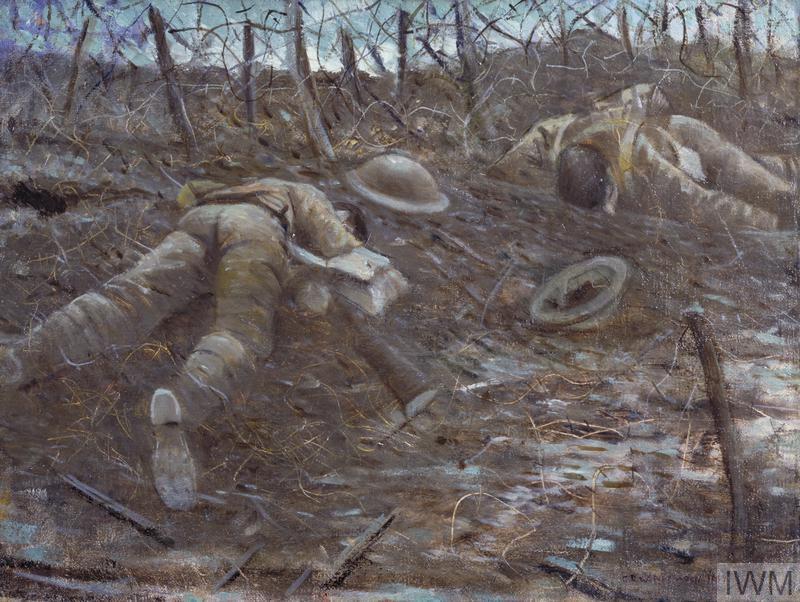
Paths of Glory, Nevinson, C R W, 1917, Canvas, oil, Support: Height 457 mm, Width 609 mm
Frame: Height 748 mm, Width 900 mm, 60, no location given
This painting shows the grim reality of war and what ended up happening to many of those fighting in this war. Death was an almost welcome end in this war as most of the brutalities faced by the soldiers were painful and long lasting. The term Shell Shock, now known as PTSD, was used to describe the mental condition of many soldiers who had faced the harsh reality of this war. Soldiers were bombarded by canon fire and gunshots and that can cause a lot of damage to one’s mental condition. Especially with what being shown in this painting it is easy to see why this war was so traumatizing to soldiers in the trenches. This painting depicts two British soldiers who have been killed, they are surrounded by barbwire and their bodies seem to blend in with the muddy ground making the scene all the more grim. What I find interesting is the choice of color for the sky in this painting, it looks to be a bright blue sky which would normally evoke the feeling of delight and it really contrasts the grim circumstances presented in this painting. I would not own this painting but I would love to see it in an art exhibition that showcases art about war.

This piece is what I consider the most gruesome out of all of the pieces I am presenting. The Trench was created by Otto Dix in the 1920’s as an effort to remind the public of the horrors that this was caused. Dix was a soldier for Germany in the first world war and was disturbed when the civilians of Germany wanted to forget the war. He wanted to remind them of the horrors faced by those fighting as an antiwar effort. He experienced these horrific events and did not want for anything like that to happen again. This painting faced a lot of controversy and it is unknown if it still exists today.It was confiscated by the Nazis during 1937 and was showcased in a “Degenerate Art Exhibition” This painting in particular being portrayed as unpatriotic. Many of Dix’s paintings were destroyed by the Nazis during World War II and while initially though to have been destroyed in 1939 when many other modernist paintings met their end this one lasted until 1940. It is not definitely known whether or not this painting still exists but it’s impact certainly does. I would really love to see this painting in person as it would feed into my morbid curiosity as to what death during the war was like and honestly I probably would have this painting hung up in my home as it really intrigues my and I feel like you would need a long time to fully dissect whats going on in this painting. I really love the color pallet with all the reds. I also really appreciate the way that the painting is sectioned off into four different scenes. Lastly I appreciate the vastness of the landscape with distorted metal beams and a guys legs creating a circular window that leads the eye to buildings in the background. What separates this from the other two paintings is the fact that it’s not just people who are living or people who are dead. It’s the dead mixed with the suffering and the living who are trying to push forward. It strikes deeper because in the first painting the men were in poor shape but definitely alive and the second had the peacefulness of death but in this piece you see the torment of those barely hanging on who are doomed to death but are not granted the mercy of a quick end.
Citations
“Gassed.” Imperial War Museums, www.iwm.org.uk/collections/item/object/23722.
“Paths Of Glory.” Imperial War Museums, www.iwm.org.uk/collections/item/object/20211.Tate.
 Phoenix's Art 200x Blog